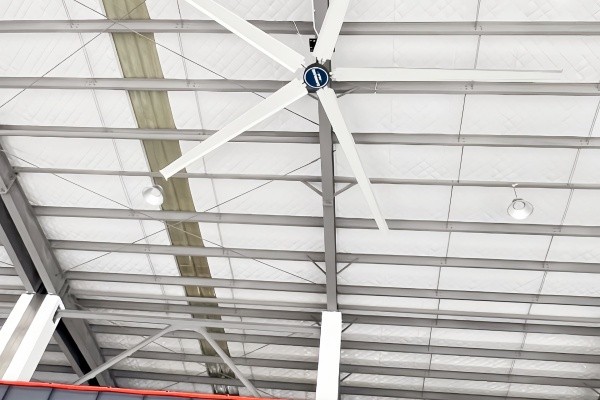
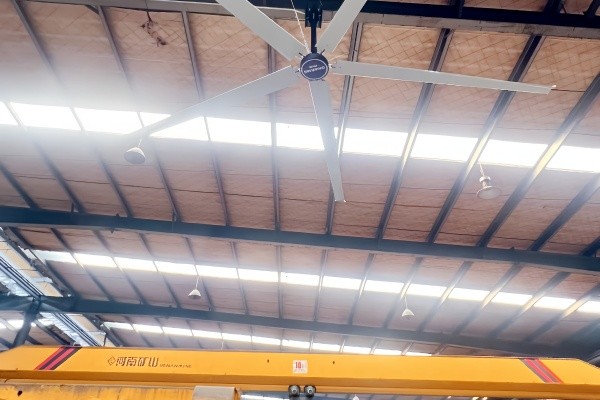
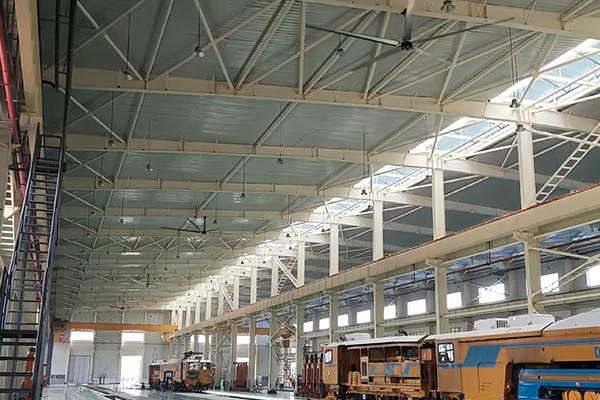
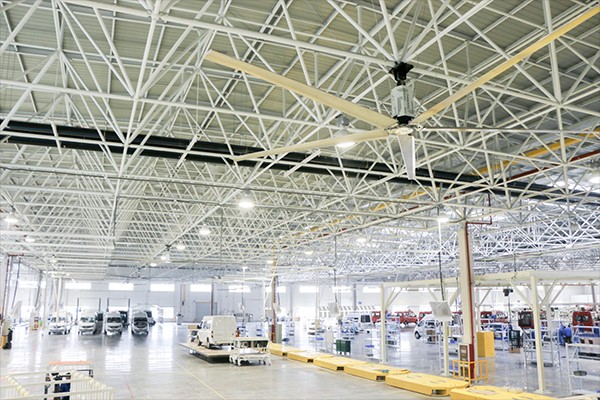
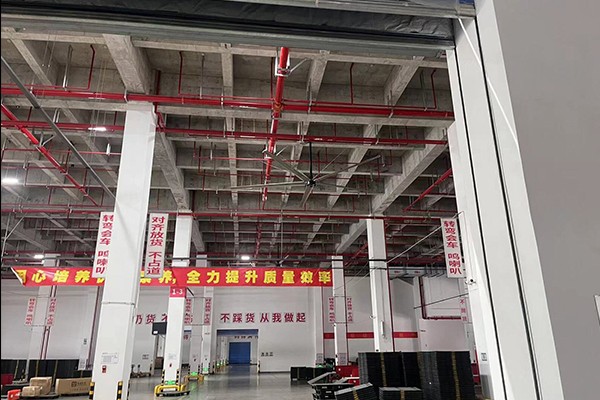
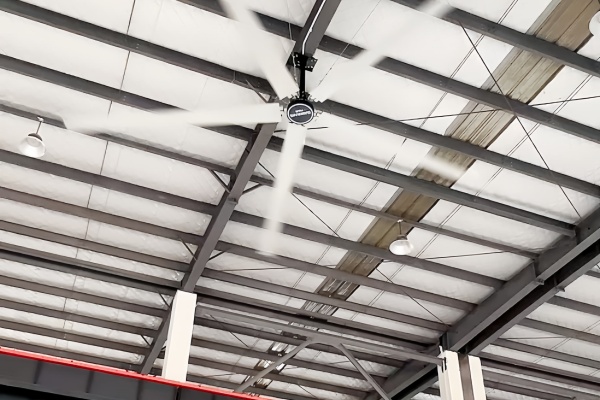
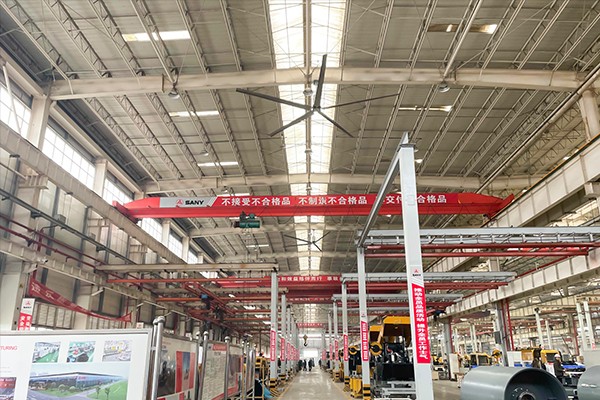
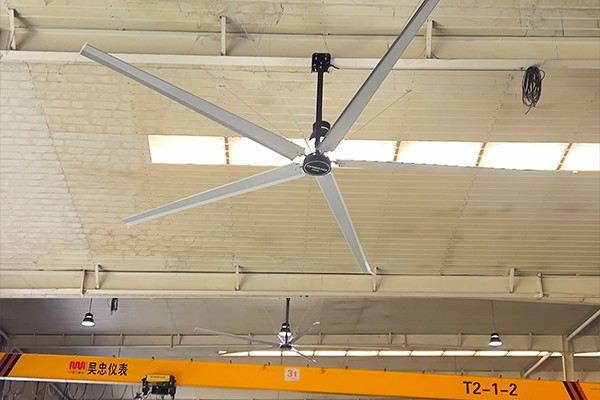
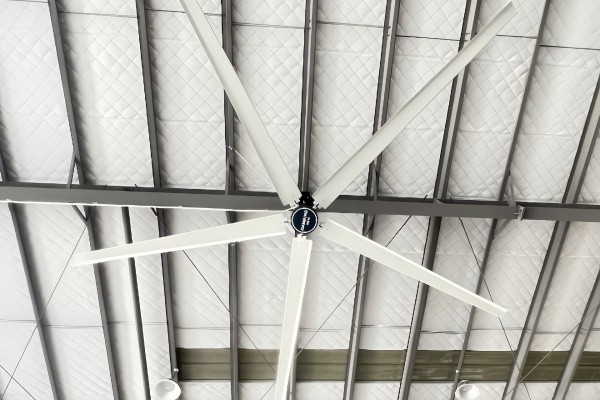
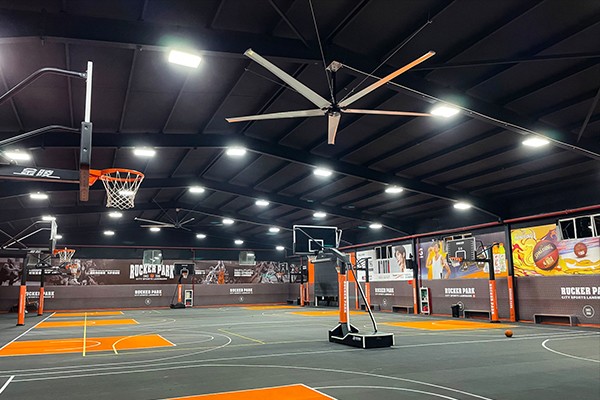
Mezzanines and tall racking divide a hall into separate airflow rooms, so a Warehouse HVLS Fan on the roof deck cannot condition the level below; treat each level as its own zone. The useful insight was simple: coverage is a property of airflow paths, not of square metres. Once the mezzanine slab was drawn as a barrier, the complaints made sense.
The slab, not the fan, was the limit
The downward air column landed on the mezzanine deck and stopped, leaving the pick faces below almost static. Heat collected above while cartons below showed moisture marks, which is a classic sign of two disconnected air volumes. Sort layouts change between peak and off-peak weeks, so re-check the zone map at each seasonal changeover. Frequent roller-door cycles bring in cold air and create local humidity swings; grouping dock-side units separately avoids wasted runtime. Log temperature and humidity at mid-line, wall racking and the dock mouth rather than relying on a single reading near the door. Carton stack height affects the floor-level spread; note the maximum height on the layout drawing. Cartons and electronic components are moisture sensitive, and gentle continuous circulation helps reduce damp at the base of stacks. Record door-cycle counts alongside humidity if the dock is the suspected cause of local damp. When comparing an HVLS fan manufacturer China, weight the model-specific test records as heavily as the headline specifications.
Two levels, two equipment families
The upper level kept a large-diameter low-speed unit for whole-volume mixing, subject to a structural check of the anchorage. Compact pedestal and mobile units served the lower aisles, positioned clear of rack uprights and escape routes. Plot permanent high stacking, luminaires, sprinkler heads and crane rails on the layout before fixing fan positions. Where ceiling anchors are approved, confirm the suspension detail against the actual truss or beam rather than a generic bracket sketch. The W.Fans series spans 3.6-8.5 m in diameter, 0.4-1.5 kW, 10-85 rpm and no more than 38 dB, covering most tall-space applications. Summer and winter speed settings differ substantially, so confirm the control system supports seasonal schedules and zone grouping. Leave a margin for future racking changes; a layout that only works for today's plan will need another survey next season. Where headroom or anchorage is limited, 4.9-6.1 m pedestal units, wall-mounted units or 1.2-2.0 m mobile units can handle local zones. A credible industrial ceiling fan supplier should be able to map every certificate and drawing to the exact contract model.
Controls and verification
Each level was given an independent group with its own humidity-based schedule. Three consecutive days of readings at fixed lower-aisle points were compared before and after the change. HVLS stands for High Volume Low Speed: a large-diameter blade set drives a column of air downward, which then spreads horizontally across the floor. Reverse rotation sends air along the ceiling first and lets it descend gently along the walls, avoiding a direct cold draft on workstations. Zone boundaries should follow racking and partitions, since a control group that straddles a barrier will never behave consistently. Low velocity over a large area will not scatter paperwork, labels or light packaging, which is why the approach suits continuous warehouse operations. Air circulation adds neither heat nor cooling; it redistributes temperature and humidity, and the measurement plan should reflect that. Low-speed mixing is judged by the uniformity of readings across points, not by the maximum velocity measured under one unit.
For practical use, the judgement criteria and evidence are compressed into one quick-reference table.
Level | Constraint | Approach |
Upper hall | Heat at roof | Large-diameter low speed |
Mezzanine slab | Blocks vertical flow | Not forced through |
Lower aisles | Racking shadow | Compact local units |
Controls | Different conditions | Independent groups |
What to put in the record
Before closing the job, confirm that the drawings, certificates and packing list all carry the same model code, and that the winter profile has been saved under a name the operator will recognise next season. These details cost nothing at handover and prevent most disputes later.
Boundaries and caveats
Mezzanines involve fire compartmentation and escape widths, so coordinate any equipment addition with the site fire design before installation. Seasonal and policy references are background only; a formal scheme requires sign-off from design, structural, fire and operations parties.
For any Warehouse HVLS Fan project, DAWANG FAN supplies layout review input, model-specific documentation and a per-unit service record from dispatch through annual inspection.