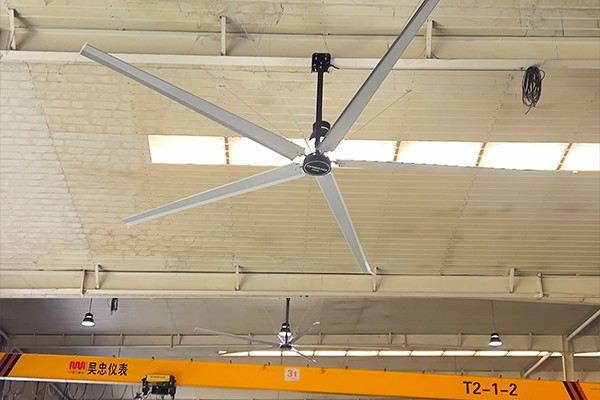
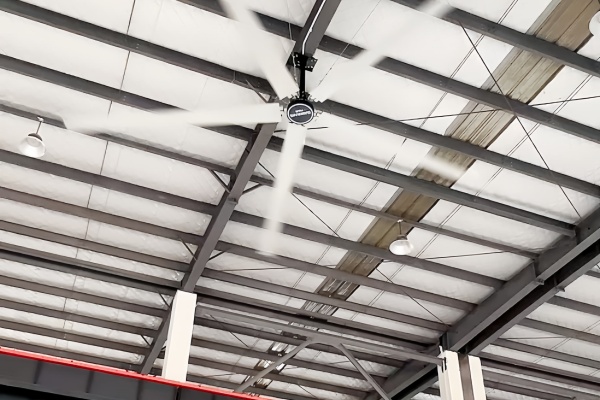
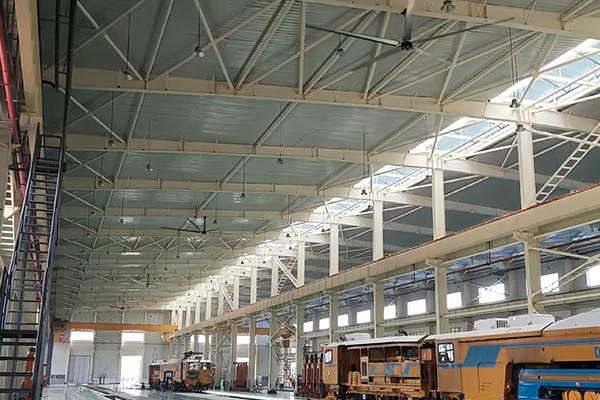
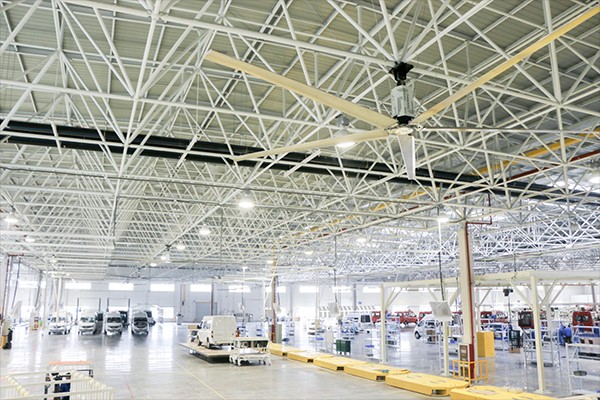
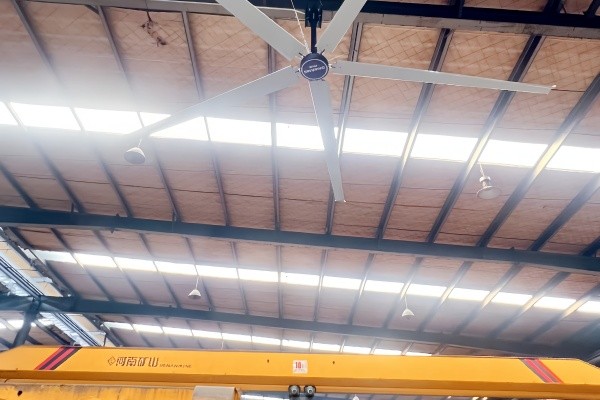
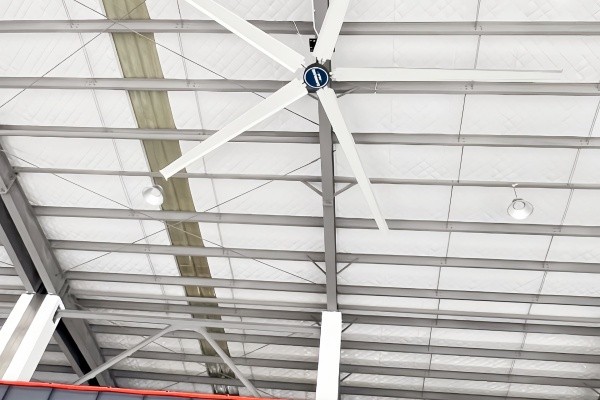
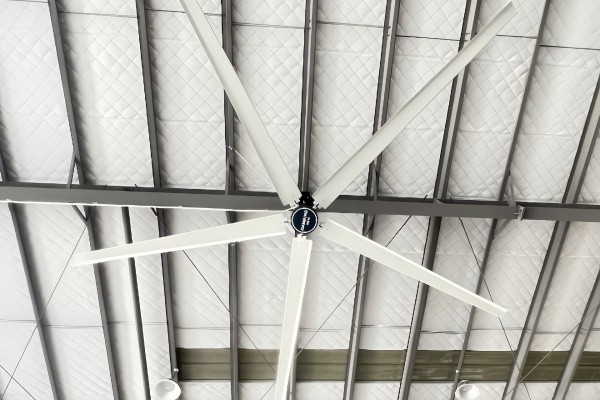
After a November sales peak, stale air in a sort hall is usually a zoning problem, not a capacity problem: group dock-side, mid-line and wall racking areas separately and run a Warehouse HVLS Fan at low speed continuously. No extra fresh-air volume was added and no setpoint was raised. The changes were limited to layout grouping and shift-based speed schedules, with all figures recorded on site.
Where the complaints clustered
Staff reported a heavy feeling at the middle of the sort line while the wall racking stayed damp and the dock mouth swung between warm and cold. Small high-speed fans reached the nearest benches only, and turning them up scattered labels and lifted dust from cartons. Carton stack height affects the floor-level spread; note the maximum height on the layout drawing. Cartons and electronic components are moisture sensitive, and gentle continuous circulation helps reduce damp at the base of stacks. Record door-cycle counts alongside humidity if the dock is the suspected cause of local damp. Returns, replacements and year-end restocking run in parallel after a peak sales event, raising both staff density and door-cycle frequency at the sort face. Temporary sort sites rarely have predictable headroom or anchor points, so pedestal and mobile units are easier to redeploy than fixed ceiling units. Sort layouts change between peak and off-peak weeks, so re-check the zone map at each seasonal changeover. When comparing an HVLS fan manufacturer China, weight the model-specific test records as heavily as the headline specifications.
Drawing zones before changing speeds
Fan sweep circles were plotted against column grids and rack heights, with permanent high stacks, luminaires and sprinklers marked as no-go areas. The dock zone was separated from the main sort band so door cycles would not drive the whole hall into unnecessary runtime. A common mistake is assuming a higher thermostat setpoint solved the problem, when the heat is still sitting under the roof trusses. Plan the winter check around a production pause, because fall-arrest and fastener inspections need the equipment isolated. Steel-structure plants see large day-night swings in autumn and winter; roof and wall surfaces can fall below the indoor dew point and start to sweat. A heating-season commissioning visit should end with a written winter profile, not just a verbal agreement about which speed felt comfortable. By mid-November most northern industrial regions are in full heating season: doors stay closed, the indoor-outdoor delta grows, and stale air, odour and local condensation appear together. Year-end output targets and safety audits overlap, so ventilation checks usually have to happen without a production stoppage or hot work.
Shift strategy and what was logged
Day shifts ran at a continuous low-to-medium setting; a brief step-up was used when humidity readings rose around paper packaging. Night shifts held the lowest effective setting to avoid a damp, stale start the following morning. The W.Fans series spans 3.6-8.5 m in diameter, 0.4-1.5 kW, 10-85 rpm and no more than 38 dB, covering most tall-space applications. Summer and winter speed settings differ substantially, so confirm the control system supports seasonal schedules and zone grouping. Leave a margin for future racking changes; a layout that only works for today's plan will need another survey next season. Where headroom or anchorage is limited, 4.9-6.1 m pedestal units, wall-mounted units or 1.2-2.0 m mobile units can handle local zones. A reflected ceiling plan is more useful at this stage than a product photograph, because it shows what the sweep circle will actually meet. Start with clear height, column grid, truss type and racking height, then estimate unit count from coverage radius rather than dividing floor area by a nominal coverage figure.
The table below groups the decision points in project order for a quick review meeting.
Zone | Observed issue | Speed strategy |
Mid sort line | Dense staff, stale air | Continuous low-medium |
Wall racking | Dead zone, damp cartons | Gentle floor-level spread |
Dock mouth | Frequent door cycles | Independent group |
Night hall | Static air | Lowest effective setting |
What to put in the record
A short record makes the difference between a repeatable setting and a one-off fix. Note the measurement points, the production load on the day, the speed band used and any alarm seen during the trial. Keep these beside the commissioning sheet rather than in a personal notebook.
Boundaries and caveats
Results depend on door-open frequency, packaging moisture and building insulation; verify with readings from the same points rather than applying a published percentage. No unverified client names, project figures or savings percentages are used; replace a scenario with a real case only after measured records are available.
As an industrial ceiling fan supplier, DAWANG FAN keeps design, production, sales and service in one chain, with model-specific factory test records and seasonal commissioning support.